back
Journalists Sensitive to Needs of Vulnerable People Help Educate a Tolerant Society

Elena Bacaliuc, Alexandru Cataraga, Liviu Lazăr, Drăgălina Gurduza (from left to right) involved in group activities. Photo: API
From July 12 to 14, the Association of Independent Press (API) organized the second edition of the Summer School "Diversity and Tolerance in the Media," which was attended by 19 journalists, reporters, staff members of national and regional media and journalism students. The participants were introduced to positive examples from national and international media of social inclusion in the media and were involved in awareness-raising exercises on the needs of social groups.
The Summer School was organized under the project "Active Citizens, Thriving Communities, Phase II," funded by the governments of Switzerland and Sweden, component "Journalists for Diversity and Inclusion: Accountability and Commitment."
The media can explain concepts and phenomena, promote examples and human stories of acceptance, offer solutions, generate emotions and rally citizens around a cause. It is therefore essential that journalists promote diversity and contribute to building a tolerant and inclusive society. The second edition of the Summer School was an opportunity for participants to exchange views, practices and experiences and to review their methods of dealing with issues affecting persons exposed to discrimination.
On the first day of the training, the director of Ziarul de Gardă Alina Radu presented several positive examples of approaching vulnerable groups, taken from the foreign press. Through short films and videos, as well as practical individual and group activities, A. Radu pointed out the need to avoid the phenomenon of "sensational approach": "Journalists must analyze in depth the cases of discriminated people, taking into account the complexity of the issue and the causes that led to a problem or situation."
The presentation of good practices was much appreciated by Xenia Adauji, reporter for eSP.md, Bălți: “It's worth noting that the first edition of the school focused on what a journalist should not do, and this year we were shown many good examples that we can adopt later.”
On the second day, there were several theoretical and practical sessions with the participation of the Executive Director of Infonet Alliance Victor Koroli. The expert gave an introductory session on the "world of people with disabilities," presenting statistics, concepts and terms, perceptions and attitudes, infrastructure and information accessibility, etc. “The role of the media is not to contribute to the re-victimization of people from vulnerable groups, but to present them in the light of their abilities. My recommendation is that the website of every media outlet should be accessible to all persons in accordance with Law No. 188 of 2012," the expert said.
The most practical and emotional part was the User Safari – an exercise to sensitize journalists to the challenges and barriers faced by people with disabilities. Participants put themselves in the shoes of people with mobility, visual and hearing impairments and understood how acute the lack of accessibility is for them.
"When I was in a wheelchair, I could barely move around the hall, I couldn't go through the door, I couldn't go down the stairs, I couldn't go to the bathroom because there were no adapted accesses for people with such needs. I felt what it was like to sit inside four walls for days on end, not being able to communicate, not being able to take care of your basic needs. You want to move, but you can't, and the people around you don't care about your problems and your needs," said Dana Moraru, reporter for Ecopresa.md.
"I walked 10 meters with a mask over my eyes for 5 minutes. The pressure of darkness is so great that you realize that happiness is found in a 'ray of light' and we simply do not have the right to discriminate against people who face such challenges every day," added Serafim Gangan, reporter for Radio Moldova.
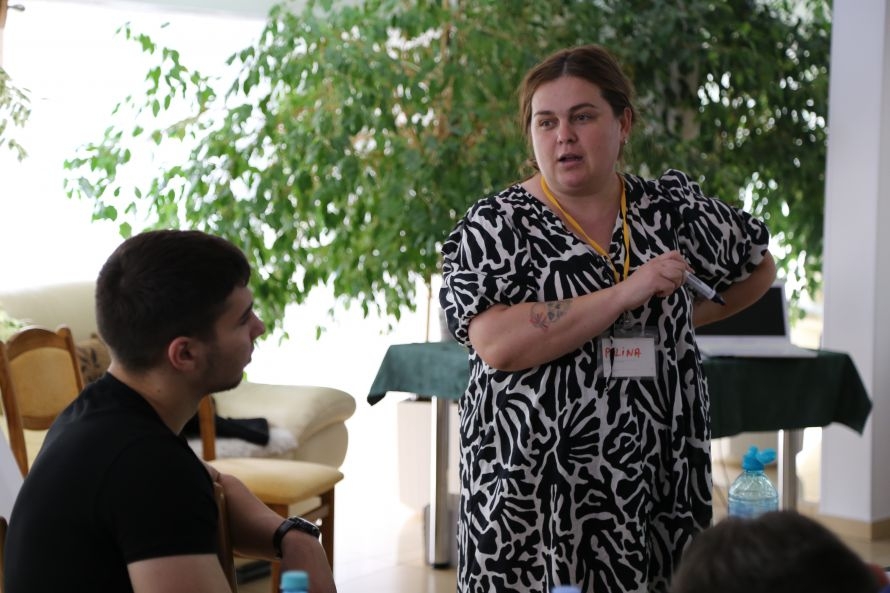
On the final day of the training, participants will work with facilitators Polina Cupcea, Oamenisikilometri.md, Marina Gorbatovschi, Ziarul de Gardă and Cristina Roșca, Suntparinte.md worked in groups from documentation, choice of topics/heroes, angles of approach to presentation of final concepts of materials about representatives of different social groups.
During the program, journalists also participated in informal discussions with some special guests, including Ceslav Panico, the Ombudsman, Alexei Buzu, Minister for Labor and Social Protection and Ian Feldman, Chair of the Equality Council, who spoke about vulnerable people as a priority for the institutions and organizations they represent.
The journalists mentioned that these discussions helped them to understand what these institutions are doing to help discriminate and/or vulnerable people and what needs to be done in the long term to move things forward at the country level, but they also appreciated the openness of the guests to provide comments and press statements. "On the one hand, it seems to us that the issues of equality, tolerance and acceptance are quite well publicized, but in reality, even we journalists know very little about the way of life and integration of a social group in society. I have to admit that those of us in the regions have fewer opportunities to ask questions and have discussions with experts in the field or officials, and this was an opportunity we saluted," said Drăgălina Gurduza, Ziuadeazi.md, Cahul.
The summer school was a program of encouragement and knowledge of journalism based on inclusion and acceptance for Viorica Costașcu, a student in the Department of International Relations, Political Science and Journalism, Free International University of Moldova: "I wish that we could have such trainings and guests at least from time to time in our study program. This would help us to choose the kind of journalism we want to practice, but also to become more empathetic and ready to interact with heroes and sources."
The event was organized under the project "Active Citizens, Thriving Communities, Phase II," funded by the government of Switzerland and Sweden, component "Journalists for Diversity and Inclusion: Accountability and Commitment."